
Travel Nursing Explained: Contracts, Recruiters, Pay & What Nurses Need to Know
If you've ever thought about becoming a travel nurse, chances are you've had a lot of questions.
How much do travel nurses really make?
How do you choose a travel nurse agency?
Can you negotiate your contract?
What does a travel nurse recruiter actually do?
And maybe most importantly: How do you know if you're getting a good deal, or getting taken advantage of?
I wanted to tackle those questions on the Life After Nursing School podcast, so I brought in someone who has seen the travel nursing industry from just about every angle.
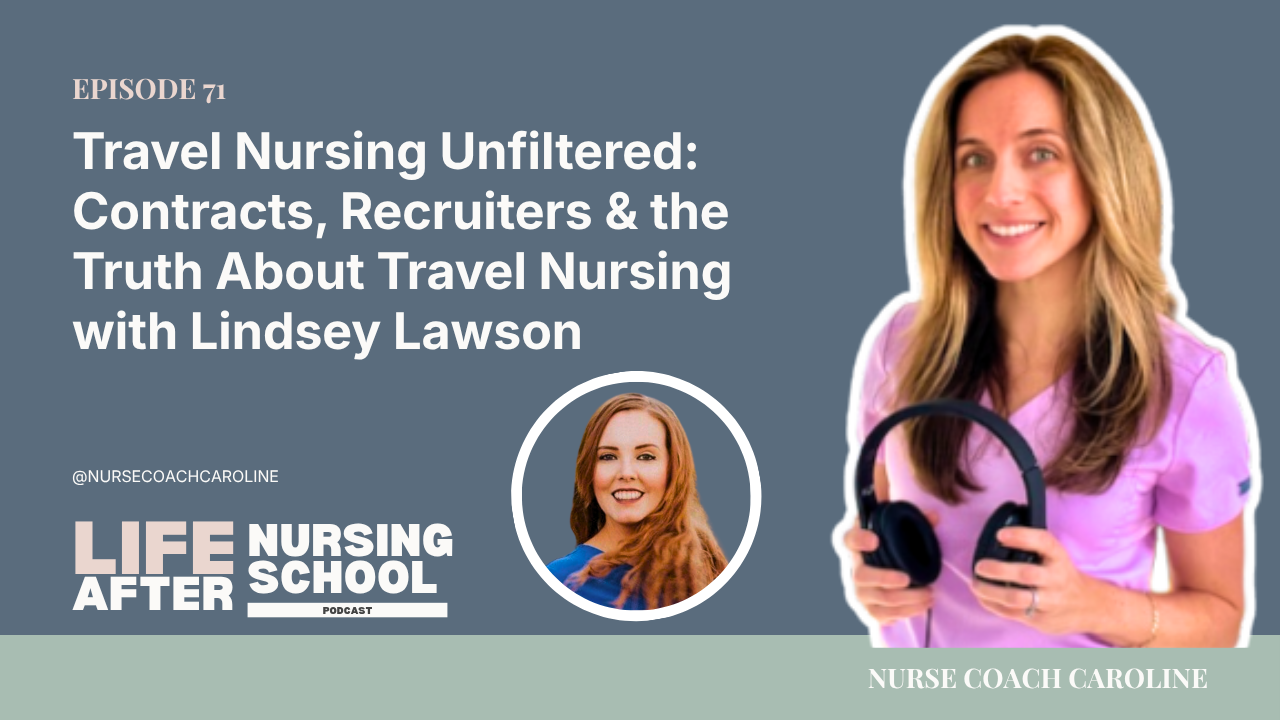
Lindsey Lawson, RN has been an LPN, RN, emergency nurse, corrections nurse, travel nurse, clinical instructor, travel nurse recruiter, author, and content creator. She started travel nursing in January 2020, just weeks before the COVID-19 pandemic completely changed healthcare.

She also spent time working behind the scenes as a travel nurse recruiter—which gives her a perspective most nurses never get.
And as someone who has also worked as a nurse recruiter and travel nurse recruiter myself, this conversation got VERY real.
We talked about travel nurse pay, recruiters, contracts, negotiating, the post-COVID travel nursing market, and some of the things agencies probably don't want nurses thinking about.
So, if you're considering your first travel nursing assignment or you're already traveling and want to become a savvier travel nurse—here's what you need to know.
There Is No One "Right" Nursing Career Path
Before we even got into travel nursing, Lindsey's career brought up an important point:
Your nursing career does not have to be linear.
Lindsey started as an LPN in 2012. Over the years, she worked in clinics, urgent care, corrections, emergency nursing, progressive care, teaching, home health, supervision, travel nursing and recruiting.
Her words? "I am the poster child for you can do whatever you want with your nursing license."
YES.
One of the biggest misconceptions nurses can fall into—especially early in their careers—is believing they need to choose the perfect specialty or career path and stay there forever.
You don't.
Your nursing license can open doors to jobs you probably don't even know exist yet.
Lindsey's career is a perfect example.
She spent two years working as an LPN in corrections, where she was responsible for medication administration and emergency triage. She described the prison healthcare environment as its own ecosystem, with services including dialysis, X-rays and dental care available within the facility.
Eventually, she became an RN and gained experience in emergency and progressive care nursing.
Then came travel nursing.
And her timing could not have been more intense.
Starting Travel Nursing Right Before COVID
Travel nursing had always been one of Lindsey's goals.
In January 2020, she finally decided to do it.
She packed up and drove roughly 1,500 miles from home to start her first travel nurse assignment in Florida.

About six weeks later, everything changed.
COVID-19 hit.
Hospitals began scrambling for staff. Pay packages changed. Contracts were rewritten. COVID units were created almost overnight.
And Lindsey was the traveler.
As she described it, when her hospital needed nurses for a new COVID unit, it was essentially: "Tag, you're it."
What started as her first travel nursing adventure quickly became something none of us could have predicted.
Lindsey continued traveling throughout the pandemic and eventually started taking crisis assignments.
At one point, she was working around 60 hours per week on night shift. During one crisis assignment, her weekly pay reached $10,200 per week.
Yes, you read that correctly. More than $10,000 per week.
But there's an important part of this story that new nurses need to understand.
COVID Travel Nurse Pay Was Not Normal Travel Nurse Pay
One of the biggest misconceptions that remains from the pandemic is that becoming a travel nurse automatically means making several thousand dollars every week.
Pandemic-era rates dramatically distorted what many people believed was "normal" travel nursing pay.
Lindsey shared that her first travel nurse assignment paid approximately $1,400 per week gross.
During COVID, she saw her pay climb dramatically, with assignments paying $3,000 per week and her highest crisis rate reaching $10,200 for a 60-hour workweek.
That's an enormous range.
And it's exactly why nursing students and new grads need realistic expectations when they see travel nurses discussing money online.
Those massive crisis rates came during an extraordinary moment in healthcare, and often alongside extraordinary working conditions.
Lindsey said that for roughly two years, she doesn't think she worked fewer than 60 hours per week.
She also watched another crisis nurse work 27 out of 30 days during a four-week assignment.
That's the part a screenshot of a weekly pay package doesn't show you.
Always look at what is required to earn the money, not just the number itself.
What Happens Behind the Scenes of Travel Nurse Recruiting?
Eventually, Lindsey's career took another unexpected turn.
Her recruiter, whom she described as an incredible recruiter who had helped her navigate becoming a traveler, suggested that Lindsey consider becoming a recruiter herself.

Initially, Lindsey wasn't interested.
Then a hospital canceled one of her travel assignments before she even started.
Her recruiter essentially told her: Take it as a sign. Come to Omaha for recruiter orientation.
She did.
That decision ultimately changed the trajectory of her career.
This is actually where Lindsey's and my paths crossed.
We were both nurses who became travel nurse recruiters around the same time, working for different agencies but training in Omaha.
And seeing the industry from the recruiter side was eye-opening.
Because travel nurse recruiting is still recruiting.
And recruiting is sales.
Your Travel Nurse Recruiter Is Working Within a Business
This doesn't mean your recruiter is bad.
There are incredible recruiters out there.
But nurses need to understand the business model they're entering.
Travel staffing agencies have metrics, financial goals and jobs they need filled. Recruiters may be under pressure to make calls, get submissions, fill certain contracts and meet performance expectations.
Both Lindsey and I struggled when those business goals conflicted with what we believed was actually best for the nurse.
I shared on the podcast that I would sometimes be encouraged to push a nurse toward a location or contract even when I already knew it wasn't what that nurse wanted.
For me, maintaining trust with the nurse mattered more than forcing a placement.
Lindsey had a similar perspective.
She explained that a nurse who becomes a recruiter often has immediate credibility with travelers because they understand what it's actually like to work those shifts and she wasn't willing to destroy that trust just to make a sale.
That brings us to one of the biggest travel nursing lessons from our conversation:
Your recruiter can be an amazing resource, but you still need to advocate for yourself.
Your recruiter cannot advocate for something they don't know you want.
Stop Being Afraid to Talk to Your Travel Nurse Recruiter
This was one of my favorite parts of our conversation because I see this happen with nurses all the time.

We're phenomenal at advocating for patients.
Then suddenly we're terrified to advocate for ourselves.
Lindsey sees travelers who are afraid to tell their recruiter:
"This pay isn't enough."
"I don't want this assignment."
"I submitted to the same hospital through another agency."
"I don't like this part of the contract."
"I need something different."
But your recruiter can't address a problem if you don't tell them it exists.
As Lindsey put it: "Can't help you if she doesn't know."
She described one of the biggest challenges for new travel nurses as learning to switch from "nurse brain" to "business brain."
That distinction matters.
Travel nursing isn't only a clinical decision.
You're also making decisions about compensation, housing, taxes, scheduling, contracts, benefits and working conditions.
You need to be willing to ask questions.
Read Your Travel Nurse Contract Before You Sign It
This might be one of the most important travel nursing tips in this entire article:
READ. YOUR. CONTRACT.
Or, more accurately, your work agreement/work order.
Lindsey now helps travel nurses understand these documents because she says many nurses sign them without fully understanding what the terms mean. Transcription with Lindsey Podc…
And some of the details can directly affect your paycheck.
She recently reviewed an agreement for a nurse that included a $25 fee for every hour the nurse worked below 36 hours.
Think about that.
What happens if you're scheduled for 36 hours but leave slightly early?
What happens in a procedural department if cases are canceled?
What happens if the hospital sends you home?
Those are exactly the kinds of details you want to understand before you sign—not after they affect your paycheck.
Before accepting a travel nursing assignment, make sure you understand things such as your required hours, cancellation terms, pay structure, time-off expectations, and any clauses that could reduce your compensation.
And if something doesn't make sense?
Ask.
Don't sign something simply because you're afraid of being difficult.
Choosing a Travel Nurse Agency vs. Choosing a Recruiter
Nurses constantly ask:
What is the best travel nurse agency?
Lindsey's perspective is a little different.
She has personally worked with Atlas and Aya and discussed positive aspects of her experience, but her bigger recommendation was to focus on the individual recruiter, particularly when you can find someone with clinical or travel nursing experience.
That makes sense.
A huge staffing company may have hundreds of recruiters.
Your experience with one could be completely different from another.
A recruiter who has actually been a nurse may understand why four 12-hour shifts aren't "just one extra day."
A former traveler may understand why housing logistics matter.
A clinician may understand why a facility's reputation, ratios or working conditions could outweigh a slightly higher paycheck.
So instead of only asking:
"What's the best travel nurse agency?"
Consider asking:
"Who's the right travel nurse recruiter for me?"
Travel Nursing Can Open Doors Beyond the Bedside
Something else struck me during this conversation.
Travel nursing wasn't just another nursing job for Lindsey.

It became a gateway to the rest of her career.
She became a recruiter.
She taught nursing students.
She built a social media platform.
She wrote a book.
Now she's helping other nurses navigate travel nursing.
And I've seen this pattern repeatedly.
Sometimes trying something new in nursing gives you exposure to an entirely different version of your career.
Travel nursing may teach you how to negotiate.
Recruiting may teach you sales.
Teaching may reveal that you love education.
Creating content may turn into speaking.
One career move can create opportunities you never could have planned.
The Part of Pandemic Nursing We Don't Talk About Enough
Our conversation also went somewhere deeper.
After working throughout COVID, Lindsey eventually began writing down her memories from the pandemic.
Specific patients.
Specific situations.
The anxiety.
The anger.
The things she didn't want to forget—or be told hadn't happened.
A year and a half later, those memories became a book.
I read it.
And what surprised me was how many memories it brought back from my own experience working during COVID.
There were moments when I found myself thinking:
Oh my God. I forgot about that.
As nurses, we're very good at compartmentalizing.
Something horrible happens?
Deal with it. Finish the shift. Come back tomorrow.
But that doesn't necessarily mean we've processed it.
Lindsey described her book less as a traditional book and more as an experience—her memories on the page, many of which were shared by other nurses who lived through that time.
And it led us into a much bigger conversation about what many nurses are experiencing now.
Why So Many Nurses Are Rethinking Their Careers
I think there is an entire generation of nurses asking:
What do I actually want my career—and my life—to look like?

Many of us had enough nursing experience before COVID to know what healthcare looked like beforehand.
Then we lived through the pandemic.
Now we're on the other side of it, and a lot of nurses are exhausted, questioning traditional career paths and looking for something different.
Maybe that's travel nursing.
Maybe it's education.
Maybe it's an outpatient role.
Maybe it's remote nursing.
Maybe it's entrepreneurship.
Maybe it's staying at the bedside—but with stronger boundaries.
There isn't one correct answer.
And perhaps one of the most valuable lessons Lindsey's career teaches us is that you're allowed to change your mind.
The Best Advice for New Nurses? Nursing Is What You Do, Not Who You Are
At the end of every episode of Life After Nursing School, I ask my guest the same question:
If you could go back and talk to yourself as a new grad nurse, what would you say?
Lindsey's answer might be one of my favorites.
She would tell herself not to let nursing become her entire identity.
"Being a nurse is what you do. It's not who you are."
WHEW.
Because so many of us do this.
We introduce ourselves as nurses.
Our friends are nurses.
Our stories are about nursing.
Our schedules revolve around nursing.
Our social media feeds are nursing.
Our sense of purpose becomes intertwined with being a nurse.
And suddenly, changing specialties, leaving the bedside or wanting something different can feel like an identity crisis.
But your nursing career is allowed to evolve.
You can be incredibly proud to be a nurse without allowing your job to become your entire identity.
Thinking About Becoming a Travel Nurse? Remember This
Travel nursing can be an incredible way to use your nursing license.
It can give you opportunities to see new places, experience different healthcare systems, increase your income, meet nurses from across the country and figure out what you actually want from your career.
But go into it informed.
Don't choose an assignment based solely on the weekly pay package. Read your contract. Ask questions. Learn how your compensation works. Communicate with your recruiter. Advocate for yourself. And remember that your recruiter and agency are part of a business relationship, even when you genuinely like and trust them.
Most importantly, don't be afraid to build a nursing career that looks different from what you originally imagined.
Lindsey started as a 21-year-old LPN.
She became an RN.
Worked in a prison.
Became an ER nurse.
Started travel nursing weeks before a global pandemic.
Worked crisis contracts.
Became a travel nurse recruiter.
Started teaching.
Wrote a book.
Built a community.
And now she's helping the next generation of travel nurses navigate an industry she's experienced from both sides.
Your first nursing job doesn't have to determine the rest of your career.
Neither does your second.
Or your fifth.
Sometimes life after nursing school is about figuring it out as you go.
As always — I have one hand for me, and the other for you. 🤍
Signing Off…
Caroline
PS. Want to listen to the full conversation? Listen to Life After Nursing School Podcast Ep 71