
Practical new grad nurse survival tips for building confidence, managing your shift, overcoming imposter syndrome, and navigating your first nursing job.
You graduated nursing school. You passed the NCLEX. You landed your first nursing job. So why do you suddenly feel like you have absolutely NO idea what you're doing?!
If you've ever walked into a 12-hour shift feeling completely overwhelmed, questioned whether you're cut out for nursing, or cried in your car after work, I want you to know something.
You're not the only one.
And feeling overwhelmed as a new graduate nurse doesn't automatically mean you're a bad nurse.
The transition from nursing school to professional nursing practice is one of the biggest adjustments you'll make in your nursing career.
You're suddenly responsible for multiple patients, managing medications, communicating with providers, recognizing changes in patient conditions, documenting everything, and somehow finding time to eat lunch.
Oh, and you're expected to do all of that while still learning how to be a nurse.
It's A LOT.
In a recent episode of my Life After Nursing School podcast, I sat down with Leah Coaxum, RN, content creator and founder of Shift Notes, to talk about the realities of being a new grad nurse.
Leah is passionate about helping new nurses navigate bedside nursing with more confidence, organization, and practical knowledge.
And after our conversation, one thing became incredibly clear:
Nursing school gives you the foundation to become a nurse, but learning how to actually function as a nurse takes time, experience, and support.
Let's get into some of the biggest lessons from our conversation.
1. Why New Graduate Nurses Feel So Unprepared
Let's start with something that might surprise you.
You can graduate from a great nursing program, pass the NCLEX, and STILL feel completely unprepared for your first nursing job.
Why?
Because there's a difference between understanding nursing concepts and managing an actual patient assignment.
In nursing school, you learn about disease processes, medications, nursing interventions, patient assessments, and clinical judgment.
And those things are incredibly important.
But nursing school doesn't always give students enough opportunities to experience the full workflow of a busy nursing shift.
Think about it.
During clinical rotations, you might be assigned one or two patients. You have time to research their diagnoses, review medications, and complete detailed care plans.
Then you graduate.
Suddenly, you're responsible for five patients, each with different medications, assessments, procedures, discharge plans, and needs.
And everyone seems to need you at the exact same time.
Welcome to bedside nursing!
The Gap Between Nursing School and Real-World Nursing

During our conversation, Leah shared how she entered nursing already knowing how to perform individual clinical skills.
She understood medication administration. She knew how to perform assessments and nursing procedures.
But putting all those skills together during a fast-paced 12-hour shift?
That was a completely different challenge.
As a nursing clinical instructor, I see this disconnect firsthand.
Nursing schools and hospitals have restrictions on what students can perform during clinical rotations. Many of those restrictions exist for important safety and educational reasons.
However, the combination of limitations can make it difficult for students to experience what a full nursing assignment actually looks like.
And then we wonder why new grads struggle during orientation!
The takeaway: If you're a new nurse who feels unprepared, recognize that there's a learning curve between nursing school and independent nursing practice.
You aren't expected to know everything on day one.
But you do need to remain engaged, ask questions, recognize your limitations, and actively participate in your learning.
2. New Grad Nurse Imposter Syndrome Is REAL
One of my favorite parts of my conversation with Leah was hearing her describe her experience as a new nurse.
After nursing school, Leah moved to Ohio, passed the NCLEX, and started working on a busy orthopedic unit.
Oh, and she was pregnant with her first child!
Talk about a lot of life changes happening at once.

She was excited to begin her nursing career, but the transition was much harder than she anticipated.
She struggled with time management.
She questioned her abilities.
And she constantly compared herself to other new graduate nurses.
Sound familiar?
Leah shared that she eventually started wondering whether she had made a mistake becoming a nurse.
She had worked so hard to get there, but suddenly she wasn't sure she could do the job.
And here's what I found so interesting.
Looking back, Leah realized that many of the things she interpreted as personal failures were actually common challenges associated with being a beginner.
Why New Nurses Compare Themselves to Everyone Else
Imposter syndrome can show up in several ways during your first year as a nurse.
Maybe you think:
Everyone else seems to know what they're doing except me.
My preceptor probably thinks I'm incompetent.
I should be faster at medication administration by now.
I keep asking questions. Am I annoying everyone?
What if I make a mistake?
Maybe I'm just not cut out for nursing.
Here's the problem.
You're comparing your beginning to someone else's experience.
Even when you're comparing yourself to another new grad, you may have completely different backgrounds, assignments, preceptors, and learning experiences.
Your nursing journey is not supposed to look exactly like anyone else's.
How to Build Confidence as a New Nurse
Confidence comes from developing competence, and competence takes practice.
Instead of expecting yourself to feel confident immediately, focus on measurable progress.
Think about something that felt intimidating during your first week.
Maybe it was calling a physician, administering IV medications, or giving report.
Does it feel a little easier now?
That's progress.
And progress matters.
Give yourself credit for the things you're learning instead of focusing exclusively on what you haven't mastered yet.
3. How to Manage a 12-Hour Nursing Shift Without Feeling Completely Overwhelmed
Let's talk about one of the BIGGEST struggles new nurses face.
→ Time management.
Because knowing how to perform nursing skills is one thing.
Knowing how to organize those skills across multiple patients during a chaotic 12-hour shift?
That's something else entirely.
Leah shared that one of the most valuable things she learned during her first year was how to establish a consistent nursing routine.
And I absolutely LOVED this advice.
Create a Nursing Shift Routine
When Leah started working on her orthopedic unit, she noticed patterns in the workflow.
Certain tasks typically happened at certain times.
There were predictable periods for assessments, medication administration, discharges, and admissions.
So she began organizing her shift around those patterns.
Rather than viewing the entire 12-hour shift as one overwhelming block of time, she broke it into smaller sections.
Her strategy? Plan your shift in approximately four-hour blocks.
For example, a day-shift nurse might organize their day around these general priorities:
Beginning of shift: Receive report, review orders and patient information, identify immediate concerns, complete initial assessments, and address time-sensitive medications and treatments.
Middle of shift: Reassess priorities, coordinate care, follow up on orders, complete scheduled tasks, and prepare for anticipated admissions or discharges.
End of shift: Continue reassessments, address outstanding care needs, update documentation, and prepare for a safe handoff.
Of course, this isn't a rigid schedule.
Patient conditions change. Emergencies happen. New orders appear.
And patient safety always takes priority over a routine.
But having a general structure gives you something to return to when your shift becomes chaotic.
Stop Putting Off Tasks You Can Complete Now
I shared something during our conversation that I learned early in my own nursing career.

If you have time to complete an important task now, don't automatically assume you'll have time later.
Because guess what?
Later, your patient might deteriorate.
You might receive an admission.
Someone might need to go to a procedure.
Or you might spend the next hour dealing with something you never anticipated.
And suddenly, that task you could have completed earlier becomes one more thing you're scrambling to finish.
This doesn't mean you should rush through patient care or skip breaks.
It means learning to recognize priorities and use your available time intentionally.
Good nursing time management isn't about moving faster. It's about working more strategically.
And as Leah pointed out, having a routine can help you leave work on time instead of spending hours catching up on documentation.
That's not just good organization.
It's also an important part of maintaining boundaries and work-life balance.
4. How to Develop Clinical Judgment as a New Nurse
Another topic Leah and I discussed was clinical judgment, which is something many nursing students and new grads worry about.
How do you know when something is wrong?
How do you recognize that a patient is deteriorating?
And how can you trust your nursing assessment when you're still so new?
Leah shared a piece of advice that I think every new nurse needs to hear:
Your head-to-toe assessment sets the foundation for the rest of your shift.
Your Nursing Assessment Is More Than a Checklist
Think about how you perform a head-to-toe assessment.
Are you simply listening to heart and lung sounds, checking a few boxes, and moving on?
Or are you really getting to know your patient?
Leah encourages new nurses to slow down enough to establish a meaningful baseline.
Talk to your patient.
Observe their behavior.
Assess their skin appropriately.
Pay attention to their breathing, mental status, mobility, and overall presentation.
Ask relevant questions.
As Leah likes to say, get in their business!
Because the better you understand your patient's baseline, the easier it becomes to recognize when something changes.
For example, imagine you assess a patient at the beginning of your shift.
They're alert, conversational, and breathing comfortably.
An hour later, you notice they're increasingly confused or experiencing new respiratory symptoms.
You might not immediately know what's causing the change.
And that's okay.
You don't need to know the diagnosis to recognize that something is different.
Your responsibility is to assess the patient, recognize concerning findings, and communicate those changes promptly using your facility's escalation procedures.
Don't Let Fear Stop You From Speaking Up
New nurses sometimes hesitate to contact providers because they're afraid of sounding inexperienced.
What if they ask a question you can't answer?
What if you're overreacting?
What if they get annoyed?
But patient safety is more important than avoiding an uncomfortable conversation.
When you're concerned about a patient, communicate what you know.
Be factual.
Describe your assessment findings.
Explain what's changed.
And if you're unsure what to do next, ask your preceptor, charge nurse, or another appropriate clinical resource for help.
Developing clinical judgment takes time.
You don't become an experienced nurse overnight.
But every assessment, patient interaction, and clinical experience gives you another opportunity to learn.
5. Your New Grad Nurse Orientation Can Make or Break Your Experience

Let's talk about something that doesn't get enough attention.
The importance of a supportive preceptor and a healthy learning environment.
Your first nursing job should provide opportunities to develop your skills with appropriate guidance and supervision.
But unfortunately, not every new grad nurse has the same experience.
Some nurses are paired with fantastic preceptors who genuinely enjoy teaching.
Others find themselves working with preceptors whose teaching styles don't match their learning needs.
And some experience workplace bullying, inadequate support, or unsafe expectations.
During our conversation, Leah and I discussed how important it is for new nurses to recognize that they have a voice in their orientation experience.
What If You Don't Connect With Your Preceptor?
Here's something I wish more new nurses understood:
You can advocate for yourself during orientation.
If you're struggling with your preceptor's teaching style, you don't necessarily have to suffer in silence.
Start by identifying what's making learning difficult.
Do you need more hands-on practice?
Would written instructions help?
Do you need clearer expectations or more frequent feedback?
Could another preceptor offer a different teaching approach?
Then have a professional conversation with your preceptor, educator, or nurse manager.
You might say something like:
"I'm grateful for everything I've learned so far, but I'm finding that I need a little more hands-on practice to feel confident with certain skills. Is there a way we could incorporate more opportunities for that during my remaining orientation?"
Or:
"I appreciate the time my preceptor has spent teaching me, but I'm wondering whether working with another preceptor for a few shifts might help me learn from a different teaching style."
There's nothing wrong with respectfully communicating what you need to succeed.
And if your concerns involve patient safety, bullying, or inadequate supervision, those issues deserve prompt attention through the appropriate channels.
Your First Nursing Job Doesn't Have to Be Your Forever Job
As a former nurse manager, I've worked with new grads who struggled in certain environments.
Sometimes the issue wasn't their ability to become a good nurse.
It was the pace of the unit.
The patient population.
The shift.
Or simply the fit between the nurse and the work environment.
I've helped new nurses explore different units or shifts when it became clear that another setting might better support their development.
And sometimes those changes made a tremendous difference.
Struggling in one nursing position doesn't mean you're incapable of being a successful nurse.
Which brings me to one of my favorite things Leah said during our conversation.
6. There Are SO Many Nursing Career Paths
Leah shared a fantastic analogy about nursing careers.

She compared nursing to a house.
Maybe you start in the living room and realize you don't like it.
That doesn't necessarily mean you need to leave the entire house.
Maybe you just need to explore another room!
I LOVE this analogy.
Because nursing offers so many different career paths.
You might begin in medical-surgical nursing and eventually discover that you love the emergency department.
Maybe you enjoy caring for patients but prefer outpatient nursing.
Perhaps you discover a passion for education, leadership, recruiting, case management, or another nursing specialty.
Your first nursing job is just that.
Your first job.
It doesn't have to define your entire nursing career.
And if you're struggling, it's worth exploring whether the issue is the nursing profession itself or your current position.
Of course, changing jobs doesn't automatically solve every problem. And leaving nursing may be the right decision for some people.
But I always encourage nurses to explore their options before assuming that one difficult experience represents everything nursing has to offer.
You have more choices than you might realize.
7. New Nurses Need More Support, Not Just More Resilience
One of the biggest themes throughout my conversation with Leah was the need for better support during the transition from nursing school to professional practice.
Because here's the thing.
We can't expect new nurses to feel confident and competent if we're not giving them appropriate opportunities to learn.
And we certainly can't expect them to thrive in environments where they're afraid to ask questions.
Leah shared how difficult it was to see other new nurses struggling emotionally during their shifts.
Some were overwhelmed.
Some were dealing with unkind coworkers.
Others were questioning whether they belonged in nursing at all.
And it made her wonder why so many new nurses were experiencing similar challenges.
That frustration ultimately helped inspire Shift Notes, her platform dedicated to providing practical resources for new graduate nurses.
How Shift Notes Helps New Nurses
Leah created the resources she wished she'd had during her own transition into bedside nursing.
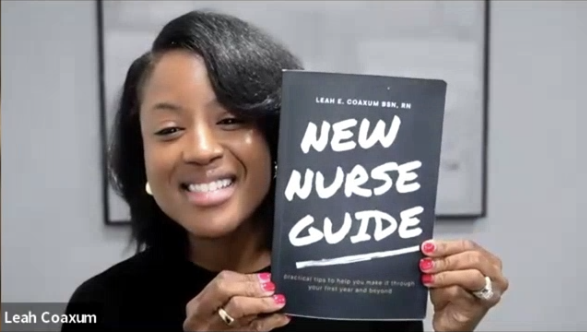
Her New Nurse Guide walks nurses through important aspects of starting their first nursing job, including navigating orientation and adjusting to the realities of professional practice.
She also offers practical tools to help nurses organize their shifts and develop routines.
What I love about Leah's approach is that she recognizes something incredibly important.
New nurses don't just need more information about nursing diagnoses and medications.
They need guidance on how to put everything together during an actual nursing shift.
They need help managing competing priorities.
They need encouragement to speak up.
They need to understand that learning takes time.
And they need to know they're not alone.
You can explore Leah's resources at Leah Coaxum's website.
8. Advice for New Grad Nurses: Give Yourself Grace
At the end of every Life After Nursing School podcast episode, I ask my guests the same question:
If you could go back and talk to yourself as a new graduate nurse, what would you say?
Leah's response was such an important reminder.
She would tell herself that the transition is difficult, but she's not the only one struggling.
She would encourage herself to keep going.
And most importantly?
Give yourself grace. A LOT of grace.
I think that's something every nursing student and new grad nurse needs to hear.
You are learning a profession that requires knowledge, critical thinking, communication, technical skills, and emotional resilience.
You're not going to master all of those things in your first few weeks.
Or even your first few months.
And that's okay.
That doesn't mean you shouldn't take your responsibilities seriously.
It doesn't mean mistakes don't matter.
It means you should approach your development with patience, accountability, and a willingness to learn.
Ask questions.
Seek feedback.
Speak up when you need help.
Celebrate your progress.
And remember that the nurse you are today is not necessarily the nurse you'll be a year from now.
Final Thoughts: You Don't Have to Have It All Figured Out
If you're a nursing student preparing for graduation or a new graduate nurse navigating your first year, here's what I want you to remember:
Feeling uncomfortable doesn't automatically mean you're failing.
Sometimes it means you're learning.
Sometimes it means you're developing new skills.
Sometimes it means you're gaining the experience that will eventually help you feel more confident.
But it's equally important to recognize when your environment isn't providing the support you need.
You deserve appropriate training, safe working conditions, and opportunities to grow.
And you have a responsibility to advocate for yourself just as you advocate for your patients.
My conversation with Leah reminded me why I love supporting nursing students and new graduates so much.
Because I've been there.
I remember how overwhelming it can feel.
And after years of working as a bedside nurse, nurse manager, recruiter, clinical instructor, and career coach, I know how much difference the right guidance can make.
So if you're currently questioning yourself, struggling with time management, or wondering whether you'll ever feel comfortable at the bedside, remember this:
You don't have to have everything figured out today.
You just have to keep learning, asking questions, and taking the next step.
And please, give yourself some grace along the way.
🎧 Listen to the Full Podcast Episode
Want to hear more practical new grad nurse advice?
Listen to “What Nursing School Doesn't Teach You: Surviving Your First Year as a Nurse with Nurse Leah” on the Life After Nursing School podcast.
Leah and I discuss the challenges of transitioning into professional nursing, practical strategies for managing a 12-hour shift, building clinical judgment, overcoming imposter syndrome, and advocating for yourself during orientation.
Whether you're preparing for your first RN job or already navigating your first year at the bedside, this episode is for YOU!
As always — I have one hand for me, and the other for you. 🤍
Signing Off…
Caroline
PS. Want to listen to the full conversation? Listen to Life After Nursing School Podcast Ep 71