
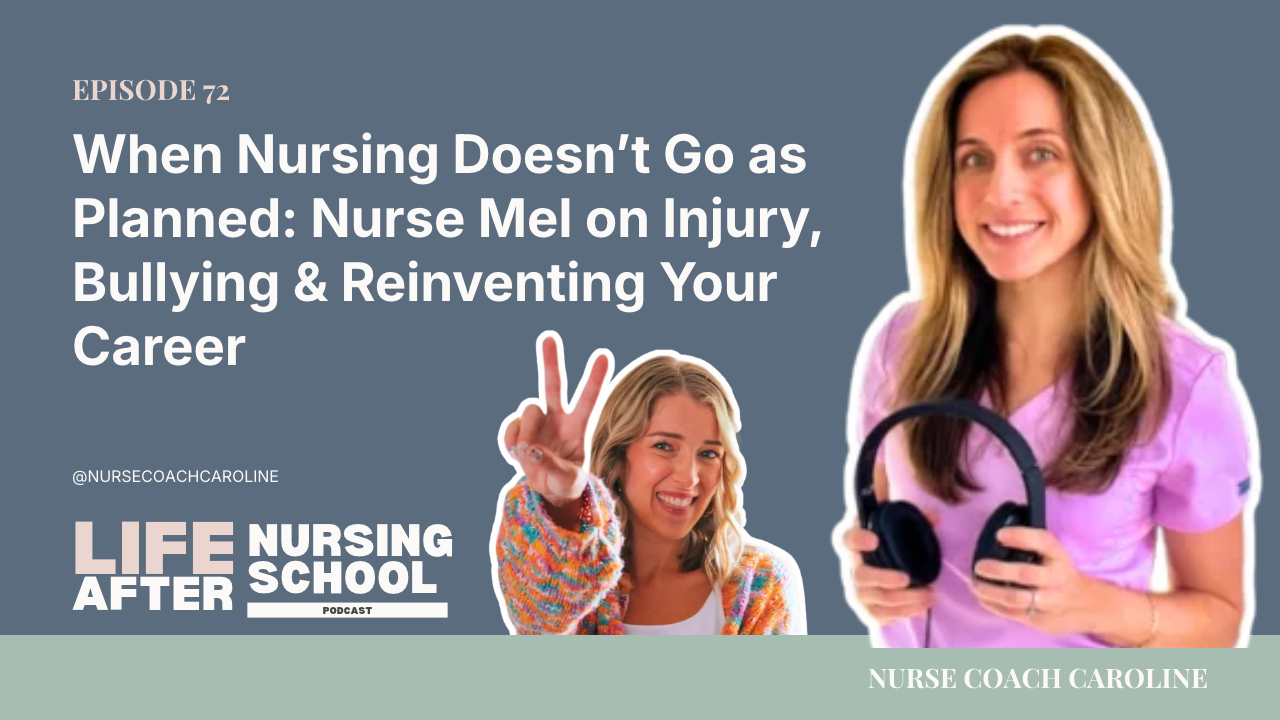
If there is one thing I’ve learned from hosting the Life After Nursing School Podcast, it’s this:
Very few nursing careers go exactly according to plan.
You graduate from nursing school with an idea of what your career will look like. Maybe you'll work in the ER. Become an ICU nurse. Go to graduate school. Travel. Become a nurse practitioner. Find your dream unit and stay there for 30 years.
And then...life happens.

Sometimes you discover you hate the specialty you thought you'd love.
Sometimes an unexpected opportunity changes your direction.
Sometimes your mental health tells you something needs to change.
And sometimes, like my podcast guest Mel VanSistine, your body makes the decision for you.
Mel, better known online as Nurse Mel, is a registered nurse, content creator and the owner of the three-time award-winning small business Mel's Crafty Corner.
But entrepreneurship wasn't Mel's original plan.
Actually, Mel genuinely loved being a bedside nurse.
Her journey from nursing student to pediatric bedside nurse to entrepreneur is a powerful reminder that reinventing your nursing career doesn't always begin because you want something different. Sometimes it begins because the life you planned is no longer available to you.
And figuring out what comes next can be messy.
Becoming a Nurse Wasn't a Straight Line Either
Mel's nursing journey began in 2013 when she started working as a Certified Nursing Assistant while attending college.
Before graduating, she also worked as a Patient Safety Companion at a children's hospital, giving her an early look at pediatric healthcare and bedside nursing.
But then came a moment many nursing students fear: Mel failed the NCLEX.
She didn't pass on her first attempt.
When you're fresh out of nursing school, failing the NCLEX can feel enormous. You've spent years working toward becoming a nurse, only to have one exam seemingly stand between you and the career you've worked so hard to build.
But failing once didn't mean Mel wasn't capable of becoming a great nurse.
She took the NCLEX again.
And this time, she passed.
That detail matters because nursing culture can sometimes make us believe everyone's career follows the same perfect sequence:
Nursing school → graduate → pass NCLEX → get dream job → live happily ever after.
Real nursing careers don't always work that way.
A setback at the beginning of your career doesn't predict what you're capable of accomplishing later.
For Mel, passing the NCLEX was only the beginning.
Finding Her Place in Pediatric Bedside Nursing
After becoming a registered nurse, Mel secured her first position as an acute care pediatric bedside nurse.
And she found her place.
Mel cared for pediatric patients across multiple specialties and diagnoses, including endocrine conditions such as diabetic ketoacidosis, pulmonary conditions including cystic fibrosis and asthma, gastrointestinal and genitourinary conditions, and mental health concerns including eating disorders and suicidal ideation.
She didn't simply show up, work her shifts and go home.
Mel became deeply involved in her unit.
She served as a charge nurse, nurse mentor and preceptor, helping support other nurses as they developed their own clinical skills.
And unlike some nurses who eventually leave bedside nursing because they've grown to hate it, Mel's relationship with bedside nursing was different.
She loved it.
In our conversation, Mel described herself as feeling like she was “born for the bedside.”
She could picture herself staying in pediatric nursing for the long haul.
That's an important distinction in her story.
Because eventually Mel did leave the bedside, but not because she had stopped loving nursing.
Her body forced her to reconsider what her nursing career could look like.
When a Physical Injury Changes Your Nursing Career
Nursing is physically demanding.
We lift.
We transfer.
We reposition.
We stand for hours.
We bend over beds, maneuver equipment and sometimes put our own bodies in terrible positions because the immediate priority is keeping our patients safe.
And sometimes those physical demands catch up with us.
Mel experienced an injury to her lower spine that ultimately required her to step away from bedside nursing.
Suddenly, the career she had expected to continue building wasn't an option in the same way it had been before.
She spent months away from the bedside recovering and going through physical and occupational therapy.
And that kind of transition involves more than losing a job.
For nurses who genuinely love clinical care, being physically unable to do it can mean losing part of the future you had envisioned for yourself.
What do you do when you still want to be a bedside nurse—but your body isn't cooperating?
That's where Mel's story becomes about more than nursing.
It becomes a story about identity.
Your Nursing Job Can Become Part of Your Identity
We don't talk enough about how intertwined nursing can become with our identities.
People don't always say: "I work as a registered nurse."
They say: "I'm a nurse."
Our profession becomes part of the way we introduce ourselves.
It becomes our community.
Our friends.
Our routines.
Our expertise.
Our sense of purpose.
And for someone who genuinely loved bedside nursing, suddenly losing access to that role can be incredibly difficult.
Mel wasn't simply deciding: "Maybe I'd like to try something else."
She was confronting the reality that something she loved might no longer work for her physically.
And while she recovered, she needed somewhere else to put her energy.
That's where creativity came in.
From Bedside Nurse to Creative Entrepreneur
During her recovery, Mel discovered a creative outlet.
What began as something different to focus on eventually became much bigger.
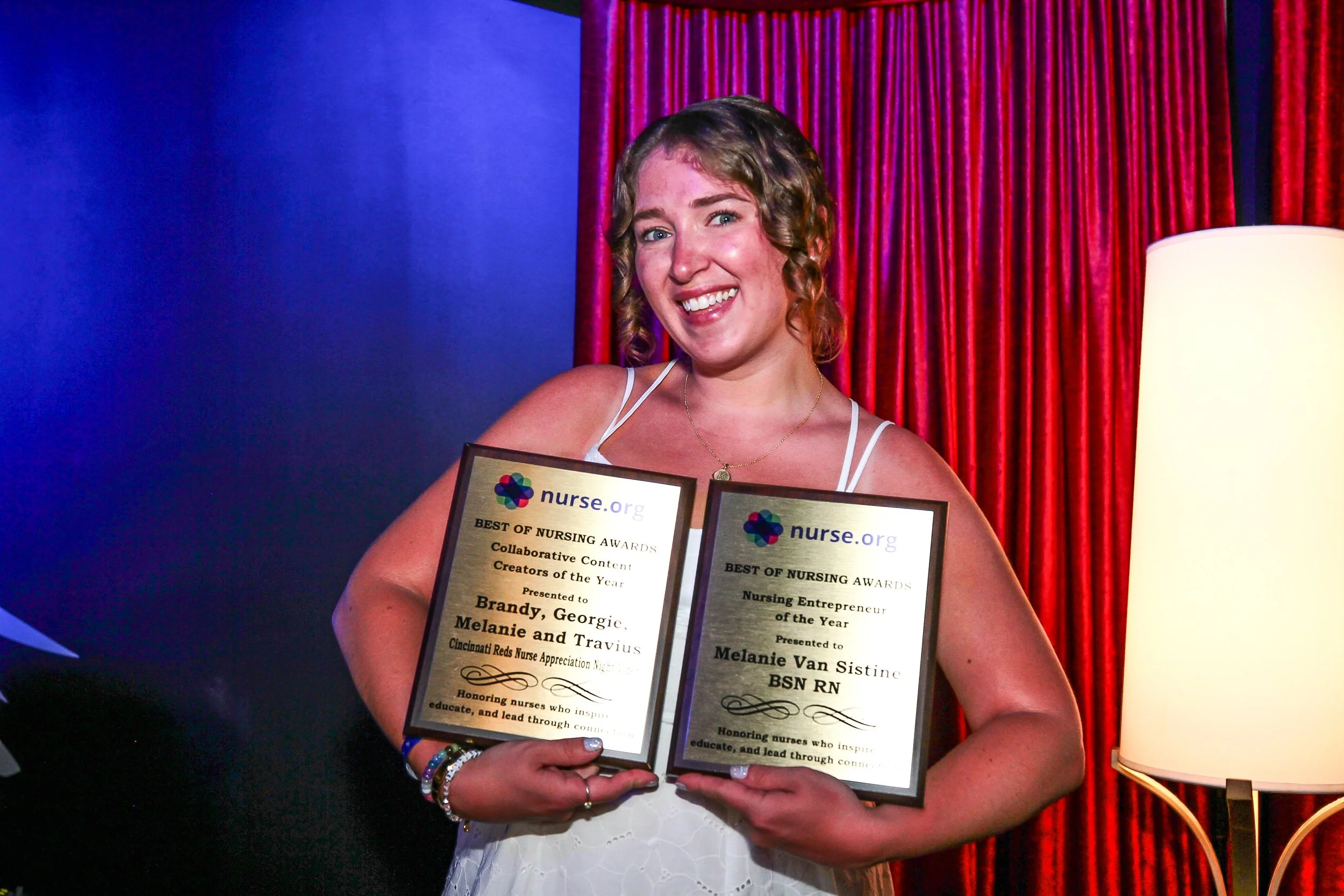
Mel's Crafty Corner was born.
Today, it's a three-time award-winning small business, and Mel has built a strong social media community around both her creativity and her identity as a nurse.
Think about how different that looks from the career plan she probably imagined when she entered nursing school.
CNA.
Nursing student.
NCLEX failure.
NCLEX success.
Pediatric bedside nurse.
Charge nurse.
Mentor.
Preceptor.
Injury.
Recovery.
Creator.
Entrepreneur.
None of those chapters erase the chapter that came before them.
They build on each other.
And that's something I think nurses need to hear more often.
Leaving Bedside Nursing Doesn't Mean Leaving Nursing Behind
There is sometimes a strange narrative within nursing that bedside nursing is somehow the "real" nursing career.
If you're not taking an assignment.
If you're not passing medications.
If you're not working twelve-hour shifts.
If you're not in scrubs.
Are you still using your nursing career?
Of course you are.
Your clinical experience doesn't disappear when you leave the bedside.
The communication skills you developed remain.
Your ability to educate remains.
Your understanding of healthcare remains.
Your ability to connect with other nurses remains.
Your leadership skills remain.
Your nursing perspective remains.
For Mel, stepping away from traditional bedside nursing eventually allowed her to connect with the nursing community in an entirely different way.
And this is one of my favorite things about nursing: There are so many ways to be a nurse.
You can teach.
Recruit.
Write.
Create.
Consult.
Coach.
Lead.
Build a business.
Work in technology.
Work remotely.
Speak.
Create products.
Or combine several of those things into a career that doesn't have an obvious job title.
Your nursing license can be a foundation rather than a box.
Workplace Bullying in Nursing Is Part of the Conversation Too
Mel and I also talk candidly about workplace bullying in nursing.
It's a difficult subject, but it's an important one.
Nursing already asks a tremendous amount from people emotionally and physically. Adding a toxic work environment or bullying from colleagues can make an already challenging profession feel even heavier.
And while resilience is a major theme throughout Mel's story, resilience should not mean accepting mistreatment.
There is a difference between: "This job is hard." and "This environment is harming me."
New nurses especially can struggle to distinguish between the two.
When you're inexperienced, it's easy to assume that being miserable is simply part of "paying your dues."
Maybe everyone gets treated like this.
Maybe you're too sensitive.
Maybe you need thicker skin.
Maybe nursing is just like this.
Those messages can keep nurses in unhealthy environments longer than they should stay.
A difficult learning curve is one thing.
Bullying is another.
Nurses Need Permission to Talk About Mental Health
Mental health is another topic Mel was willing to discuss openly in our conversation.
And I'm grateful anytime a nurse is willing to talk about it.
Healthcare professionals can be incredibly good at caring for other people while simultaneously ignoring what is happening within themselves.
We're trained to function.
We're trained to respond.
We're trained to move on to the next task.
You can be having one of the hardest days of your life and still need to walk into another patient's room with a smile on your face.
That ability can be useful in a crisis.
It can also make us very good at pretending we're fine when we're not.
One of the themes throughout my conversation with Mel is the importance of asking for help.
That doesn't make you less capable.
And it doesn't erase your accomplishments.
Sometimes resilience isn't white-knuckling your way through another terrible season.
Sometimes resilience looks like recognizing:
I cannot keep doing this alone.
Reinventing Your Nursing Career Doesn't Mean You Failed
This is probably the biggest takeaway I had from Mel's story.
A career pivot can feel like failure when it wasn't part of the plan.
If you spent years becoming a bedside nurse and then leave the bedside, was all that education wasted?
If you worked toward a specialty and discover it isn't right for you, did you choose wrong?
If an injury means you can't continue doing the job you trained for, does that mean your nursing career is over?
No. A change in direction doesn't invalidate everything that came before it.
Sometimes your previous experiences are exactly what prepare you for whatever comes next.
Mel's years in pediatric nursing gave her an understanding of nurses and healthcare that she now brings into the community she has created.
Her creativity didn't replace her nursing experience.
It became another way of expressing it.
And I think that's a distinction more nurses need to hear.
You don't necessarily have to choose between being a nurse and being something else.
You can be both.
What Are Alternative Careers for Nurses?
One reason I love conversations like this on the Life After Nursing School Podcast is because nursing students often have such a narrow view of what a nursing career can become.
That's understandable.
In nursing school, most of your exposure is to traditional clinical roles.
Med-surg.
ICU.
Emergency.
Labor and delivery.
Pediatrics.
Psychiatry.
Those are incredible careers.
But they aren't the only options available to nurses.
If bedside nursing is no longer right for you—whether because of burnout, injury, family responsibilities, your mental health or simply because you want something different—your nursing experience can potentially translate into areas such as:
Nursing education
Healthcare recruiting
Case management
Utilization review
Legal nurse consulting
Nursing informatics
Healthcare technology
Medical writing
Content creation
Entrepreneurship
Corporate healthcare roles
Nurse coaching
Consulting
Speaking and education
And sometimes the next opportunity won't even be something you can find by typing "RN jobs" into a search bar.
You may have to build it.
That's scary.
It's also exciting.
You Don't Need to Know the Entire Plan
There's a tendency among ambitious people to want the next five steps mapped out before taking the first one.
Nurses are particularly susceptible to this because our profession is built around plans.
Care plans.
Treatment plans.
Discharge plans.
Five-year career plans.
But life doesn't always cooperate.
Mel didn't know when she injured her back that her recovery period would ultimately contribute to an entirely new chapter of her professional life.
Sometimes all you know is: The way things were isn't working anymore.
That may be enough information to start.
You don't necessarily need to know exactly where you're going before allowing yourself to explore something different.
Try the class.
Apply for the job.
Start creating.
Write the first page.
Open the social media account.
Make the product.
Talk to someone doing the job you're curious about.
Explore.
Your next career doesn't necessarily arrive as a perfectly packaged opportunity with a neon sign that says: THIS IS YOUR PURPOSE.
Sometimes it starts as the thing helping you get through a difficult season.
Your Nursing Career Is Allowed to Evolve
I think one of the hardest things for nurses to accept is that something can be right for one season of your life and wrong for another.
You can love bedside nursing, and eventually leave it.

You can be grateful for your nursing career, and want more.
You can be incredibly proud of becoming an RN, and build a business.
You can miss patient care, and still know that returning to the bedside isn't right for you.
Two things can be true at once.
Mel's story isn't about escaping nursing.
It's about evolving within and beyond it.
And that is exactly what Life After Nursing School is about.
There is no one correct way to build a nursing career.
"It's All Gonna Be Okay, Babe"
At the end of every episode, I ask my guest some version of the same question: If you could go back and talk to yourself as a new grad nurse, what would you say?
Mel's answer was simple: "It's all gonna be okay, babe."
And honestly?
Maybe that's what someone reading this needs to hear too.
Maybe you failed the NCLEX.
Maybe your first nursing job is nothing like you expected.
Maybe you're dealing with bullying at work.
Maybe you're struggling with your mental health.
Maybe an injury or illness has changed what you're physically able to do.
Maybe you're burned out.
Maybe you don't know if you want to be a bedside nurse anymore.
Maybe you have a creative idea or business sitting in the back of your mind that feels completely unrelated to the career you spent years building.
Or maybe you're simply looking around and thinking: Is this really what I'm supposed to do for the next 30 years?
Your next chapter doesn't have to look like your last one.
And changing direction doesn't mean everything you did to get here was wasted.
You are allowed to take the skills, experiences, relationships and lessons nursing has given you and use them to build something different.
Sometimes the career you planned works out beautifully.
Sometimes it doesn't.
And sometimes the detour becomes the story.
As always — I have one hand for me, and the other for you. 🤍
Signing Off…
Caroline
PS. Want to listen to the full conversation? Listen to Life After Nursing School Podcast Ep 72